
Laxmi Rani
Counseling Psychologist | Mental Health Counselor | Relationship Counselor +4 more
New
17+ yearsOnlineGhaziabadEnglish, Hindi
Bookable sessionsExperiencedFrom ₹1000AnxietyDepressionStress Management
Compare trusted psychologists by expertise, care mode, and location. Choose confidently and book support that fits your life.
Not sure what you need?
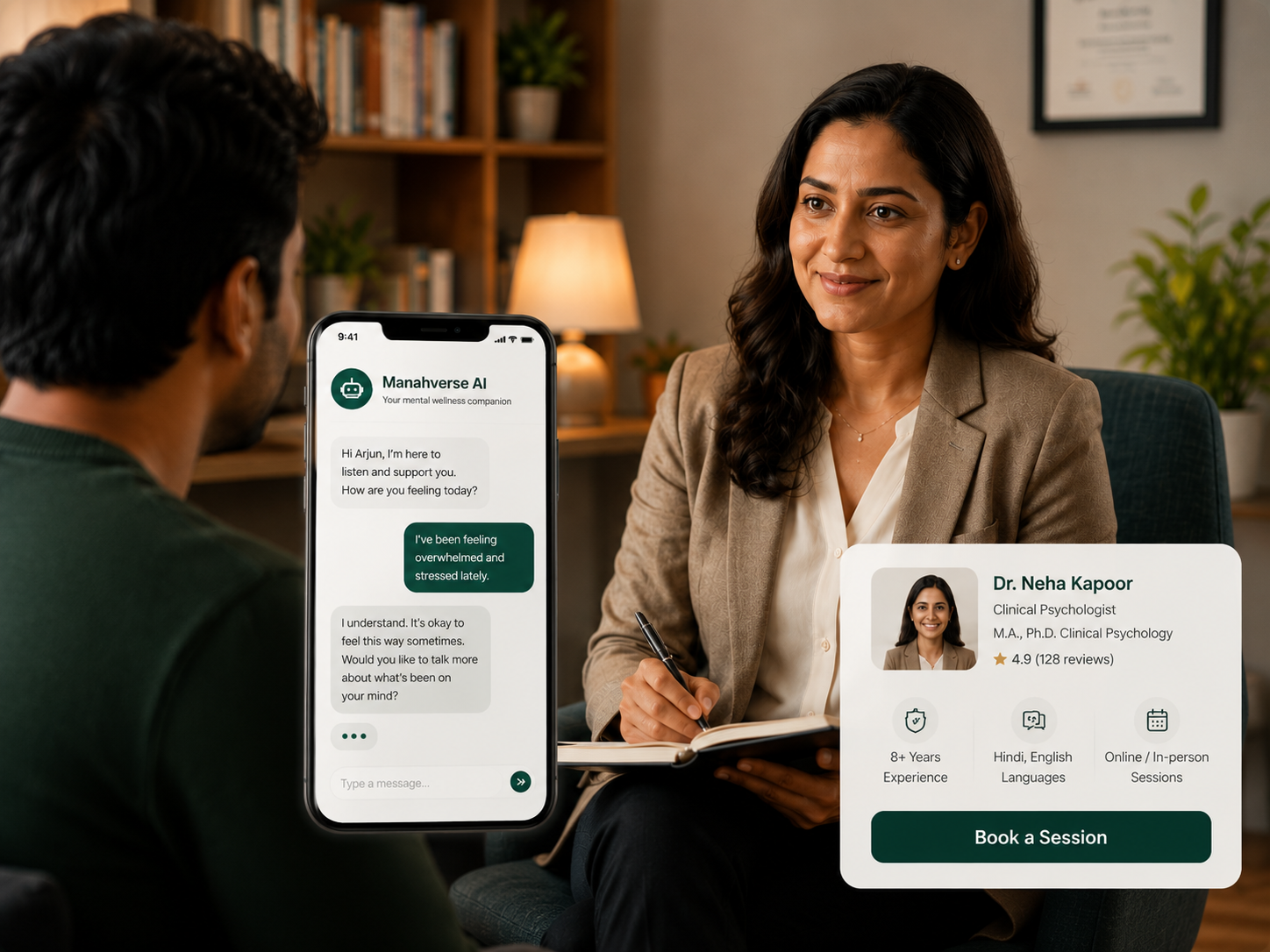


Care on your terms
Online, in-person, or a flexible mix
Professional care types
Explore professional formats by focus area, then compare certified mental health practitioners who provide it.
Upcoming workshops
Join focused, supportive sessions on the concerns that shape everyday wellbeing.
Self-Care & Community
Whether you want a private reflection diary or you are a professional wishing to share insights, we have spaces built for you.
Reflect on your day, track your moods with emojis, record gratitude, and log self-care goals. Access psychological prompts designed to guide your emotional introspection. Completely private.
Registered psychologists and practitioners can author educational articles, respond to public community forums, and guide thousands of clients seeking mental well-being advice.
Top profiles
Recommended by profile quality, bookable sessions, verified reviews, trust signals, and marketplace activity.
Counseling Psychologist | Mental Health Counselor | Relationship Counselor +4 more

Child Psychologist | Rehabilitation Psychologist | Career Counselor +9 more
Licensed psychologist
Counseling Psychologist | Relationship Counselor | Mental Health Counselor

Counseling Psychologist | Mental Health Counselor | Life Coach +12 more

Counseling Psychologist | Relationship Counselor | Family Counselor +1 more

Child Psychologist | Counseling Psychologist | Career Counselor +13 more
Browse by concern
These areas of concern are drawn from the expertise of verified professionals currently on Manahverse.
Care near you
Discover verified professionals in active Manahverse locations, with online options available beyond city limits.
Mental Health Insights
Read expert advice, guides, and therapeutic perspectives on various psychological topics.
Have you ever felt like you put away work because it felt too much? Sometimes it feels like you’re repeatedly recalculating the route instead of actually driving. The freeze mode, or that feeling when you feel overstimulated? It feels draining and impossible; hence, putting the task away or avoidance makes it the best option for you to feel at ease again. Shame exacerbates it even more. Fear of judgement, exhaustion/burnout, uncertainty, or even perfectionism come as hurdles to completing the tasks. Why do we procrastinate after all? Are you lazy as the “Indian parents” say? Definitely not! All your life, you have been misunderstood, and I know that feeling; you begin to feel alone, as though nobody understands you. Questions arise: what if you do not succeed or reach that goal due to uncertainty? You get stuck in the avoidance cycle. That brings me to the next question—what really happens when you avoid? A sense of anxiety comes up—fixation on the worst-case scenario, doubts about ability to cope, palpitations, overthinking, and irritability following that avoidance due to the anxiety spurs. Hence, you do not do the task at all (school homework, work, etc.), so a sense of relief comes in; however, that relief is only temporary, and the anxiety/shame intensifies, and you judge yourself even more. Little do we know that this actually makes you stay stuck in the loop and worsens it. Moving on, you must be wondering—how do I cope with this? Yes, it is hard and requires grave attention and consistency to break the pattern of procrastination. Perhaps, you would’ve heard about SMART goals (Specific, Measurable, Achievable, Relevant, and Time-Bound). Break your task into small parts and learn to take the help needed (whether it be financial, social, or even emotional) and delegation, but alongside making an accountable promise to yourself that you will trust yourself and take breaks too, but complete this. I feel it is very important to notice how you talk to yourself at that time—is it the loud critical voices? How do you feel in your body at that time? Tight stomach knots, tense shoulders, heavy chest? Pause and breathe first—it can be through diaphragmatic breathing, box breathing, butterfly hug, or any somatic exercise that eases you. Afterwards, knowing what you are telling yourself at that time, changing the words or rephrasing, and of course not forgetting—social support plays an integral role as well. Last but not least, what is stopping that little girl/boy within you from trusting yourself again? How can you connect to that inner child in you and build that trust again? These are important questions you must ask yourself today! Take that step for yourself; you deserve the best.

Diya Sharan
MA in Psychology
The Scroll That Never Ends: How Doomscrolling Is Quietly Wrecking Your Workday You open your phone for "just a second" between meetings. Twenty minutes later, you've read three breaking news alerts, a thread about layoffs at a company you've never worked for, and a post about the economy that made your stomach drop. Your next meeting starts in ninety seconds and your heart is already racing. That's not a coffee break. That's doomscrolling — and it's become one of the most under-the-radar contributors to workplace stress today. It's More Common Than You Think Doomscrolling isn't a fringe habit anymore. <cite index="1-1">Roughly 31% of U.S. adults doomscroll regularly, a number that climbs to 51% for Gen Z and 46% for millennials</cite> — which, notably, describes a huge share of the modern workforce. This isn't happening only at night in bed. It's happening between Slack messages, during lunch breaks, and in the ten minutes before a big presentation. The Work Connection Is Real, Not Just Anecdotal For a while, doomscrolling was treated as a personal habit — something to feel a little guilty about, like snoozing your alarm too many times. But research is now drawing a direct line from the scroll to the workday itself. A study following hundreds of employees over time found that <cite index="7-1">doomscrolling is a potent source of stress for workers — especially those higher in neuroticism — and it measurably lowers engagement with one's work</cite>. In other words, this isn't just "feeling a bit off." It's a documented drop in how present and effective people are on the job. Harvard Health has pointed to the same feedback loop many of us recognize instinctively: <cite index="1-1">workers who doomscroll during the workday tend to become less engaged with their professional tasks</cite>, and as one Harvard Medical School expert put it, stress is what triggers the urge to scroll in the first place — and the more you scroll, the more that urge grows. It's a loop that feeds itself, and it plays out in real time on the job. Your Body Doesn't Know the Difference Here's the part that surprises most people: your nervous system doesn't distinguish between a real, immediate threat and a distressing headline on your phone. <cite index="6-1">The body responds to disturbing content online with the same stress response it reserves for physical danger</cite>, which is why doomscrolling has been linked to elevated cortisol, disrupted sleep, a faster heart rate, and tension headaches. Now imagine layering that stress response on top of a full workday. Deadlines, difficult conversations, back-to-back meetings — and a nervous system that's already primed for "threat" because of what you read at 8:47 a.m. It's little wonder that burnout numbers are climbing: <cite index="5-1">66% of U.S. employees now report feeling some form of burnout</cite>, and workplace stress statistics show that <cite index="3-1">more than 40% of employees globally report feeling stressed for much of the workday</cite>. Why It's So Hard to Just "Put the Phone Down" If willpower alone solved this, doomscrolling wouldn't be a trend with its own name. Part of the problem is that scrolling often feels like a coping mechanism — a way to numb out or feel briefly in control — even though <cite index="4-1">for people already carrying anxiety or stress, doomscrolling functions less like relief and more like a maladaptive loop that feeds the very stress it's meant to soothe</cite>. That's the trap. The habit that's supposed to give your brain a break during a stressful workday ends up recharging the stress instead. What Actually Helps The good news: this pattern is well understood enough now that there are real, practical ways to interrupt it — not by white-knuckling your way off your phone, but by giving your nervous system something better to do with that stress in the moment. Notice the trigger, not just the habit. Doomscrolling is usually a response to an uncomfortable feeling — boredom, dread, overwhelm. Naming the feeling in the moment is often more effective than fighting the phone itself. Build in real recovery, not just distraction. A five-minute scroll doesn't lower cortisol. A short walk, a breathing exercise, or a real conversation does. Get support before it compounds. Chronic low-grade stress rarely announces itself loudly — it just quietly erodes focus, sleep, and patience, day after day. That last point is where a lot of people get stuck. It's hard to interrupt a stress-and-scroll loop entirely on your own, especially when work itself is part of what's fueling it. Where Manahverse Comes In This is exactly the space Manahverse sessions are built for — a place to actually unpack what's driving the stress behind the scroll, rather than just trying to manage the symptom. If work stress has started to feel like background noise you've stopped noticing, or if you recognize yourself in that stress-scroll-stress loop, a session is a good place to start pulling it apart with someone who can help. You don't have to wait until it turns into burnout to talk about it. Sometimes the most useful hour of your week is the one where you finally put the phone down and talk it through instead. Ready to break the cycle? [Book a session on Manahverse] and give yourself a better place to land than your feed.

Vanshika
MA in Psychology
“What if I don't earn enough in the future?" "What if I don’t succeed?" “ What if I never get that job?" Familiar? Relateable? I know how difficult these thoughts might be. It sounds so real indeed. It is equally relatable for me as well. Life really throws you into anxiety-provoking situations, right? It’s like we’re in the lion's den, not knowing whether we will be able to fight back and come back stronger and proud or get swallowed in the lion’s body. Okay, yes, I made it sound scarier haha! Let’s take it like this- it is like walking in a dark tunnel on a straight line, not knowing where the light is—you can see the light, but the light is far away. Better? As Tara Brach says, “We wait for things to be different to feel okay with life. As long as we keep attaching our happiness to the external events of our lives, which are ever changing, we’ll always be left waiting for it.” Don’t you just agree? Happiness, when tied to external events, will always lead to unhappiness because of its unpredictability. It’s easy to say to detach but difficult to practice; indeed, knowing how to make an effort in every situation consciously is truly going to help make detachment easier one day. The word "uncertainty" means "unsureness." That does sound scary indeed; however, trying is better than not trying at all—wouldn't it lead to regret after all? We all set out in the world with our set of dreams, hoping that what we put our heart and soul into should also work out right away. We want that guarantee, but what if I say there wouldn’t be any guarantee? Maybe it will work out, but not when you want it to. I help clients notice what is in their control here and out of their control. The majority of the time, we overthink or fixate our minds on things that are out of our control, such as the result, the timeline, or the duration of that event. That brings me to the next question: do you trust yourself? What is self-trust after all? Yes, reminding yourself every day that no matter what happens—I will be okay even after that breakup/divorce, after getting fired from the job, after being unemployed, after that failed exam, or even after the end of a long friendship. We feel that when a negative experience does occur or if something is delayed, our mind automatically assumes the worst or that the worst will happen. What if I tell you that the best can also happen? Why only the bad? Why not the good? Our brain is made in such a way that it will attract the negative—the negative event, the negative news. It isn’t used to dealing with delays due to a gap. The catch is taking a pause and catching yourself the next time you begin to believe the negative thought related to the uncertain situation and asking: is this worth my energy?" " This thought is merely inducing fear in me, and lastly, what is this fear trying to tell me here? Last but not least, it can be scary to face the world out there not knowing what is going to happen, but do we have to fix that thought right away? It is okay not knowing some answers too, and that does not mean that the worst will happen. Talking to yourself gently and kindly is something that will take you a long way. Remember, next time you feel low due to the uncertainty, just take a deep breath and go do something enjoyable, or talk to someone you love or trust; it is time to live life too!
Diya Sharan
MA in Psychology